Hope is the thing with feathers
Mark LaMonda
__________
For some reason it seemed that most of what was in our house was either my father’s or my sister’s. My mother had been dead for three years, and my father favored my sister.
But, my father did give me an African grey parrot for my twelfth birthday. Sure, my birthday was still over three weeks away but it was mine. He suggested that we name it Hope, after the Dickinson poem – Hope is the Thing with Feathers.
My best guess as to how I ended up with a parrot three weeks early, is that someone owed my father a few bucks and he agreed to take the bird after having a few too many seven and sevens. He then remembered that my birthday was coming up at the end of the month. He was definitely a kill two birds with one stone kind of guy, and my birthday was like one of many tasks on his list. He was thrilled to mark it complete and be done with it. My father then tried to elevate the gift by reciting the famous lines of the poem he had memorized in High School; happy to give the impression that this was an intentional gift, one that was given with deep care and thought.
My father was a plumber, like his father before him, but liked to talk about the one year he spent at a community college. He liked to say, “I’ve been to college – In the front door and out the back.”
He once gave my little sister Kate a cat for her birthday and quoted Mark Twain, “Women and cats will do as they please, and men and dogs should relax and get used to the idea.” I remember he winked at me as though I had any idea what he was getting at. The box the cat came out of was one I had seen in the back of his pickup truck, so I was pretty certain that he had scooped the cat from the street.
My sister loved the cat and named it Snuggle Bunny. She mothered the cat the way she remembered our mother taking care of us.
My bird was called Hope, but I privately called it Fuck-Shit because of the hardcore vocabulary it came with. I think the bird was damaged beyond its broken wing because it was perpetually hostile. To feed him we made a makeshift funnel that we could use to slide its feed into the cage. My father was the only one who could go near the bird, but even he wore a large leather apparatus on his arm.
Once when my father was trying to clean the cage, I saw him smack the bird, the bird he called Hope, off its perch when he thought the bird was about to attack. The bird laid still for a moment on the bottom of the cage, and then slid to the corner with its head down, but eye cocked looking carefully at my dad.
For me, I was interested in the bird’s ability to speak. Hope sounded like she had been a sailor’s bird. “Fuck, Shit,” were its favorite words. My father said, Hi, Hope. Hi Hope, and pretty bird, pretty bird, over and over again hoping to change its vocabulary.
Every time my father was out of the house, and this was quite a lot of the time, I reinforced Shit and Fuck, and eventually got Hope to say Goddamned-it pretty regularly as well.
After observing my father smack Hope around a few more times I began to worry about her. Hope was vulnerable. I backed off on the Fuck-Shit and focused on Hello. “Hello. Hello,” I would repeat.
In the end, Hope became my sister’s bird, as did all the animals that strayed within our overly testosterone-driven walls. I realized this one afternoon when I said hello to Hope and the bird said, “I’m Nobody! Who are you?” My sister clapped and cooed, “Good bird. Pretty bird. I’m Nobody! Who are you?”
__________
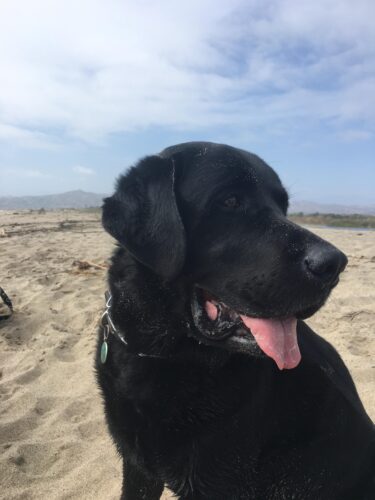
Otto, Mark LaMonda’s dog.
__________
Mark LaMonda is an artist and writer who lives in Santa Clarita California. His work has appeared in California Quarterly, Painted Bride Quarterly, Lullwater Review, and is forthcoming in Tough Poets Review and South Florida Poetry Journal.
__________

To learn more about submitting your work to Boudin or applying to McNeese State University’s Creative Writing MFA program, please visit Submissions for details.
Posted in Third Annual Pet Writing Contest and tagged in #boudin, #fiction, #flashfiction, Fiction