
The New Human
Shelagh Hardrich
__________
She heard it before she understood it.
A sound like the mountain clearing its throat — low and rolling, wrong in the way thunder was wrong when there was no cloud. She was inside, in the good warm spot near the heating box, and then she was at the door because something in her chest said go, and then she was outside, running toward the sound because Noah was out there and Nathan was out there and the sound had stopped but something else had started, something worse: Noah’s voice, saying a name, over and over, in a register she had never heard from him before.
She ran faster.
The slope was chaos. White everywhere, still shifting in places, and Noah at the edge of it making sounds she didn’t have a shape for. She ran to the edge too. She could smell Nathan — she could smell where he had been, the ghost of his warmth on the snow — and underneath that, nothing. Just cold and rock and the particular emptiness of a scent that stopped. She barked. She barked because she needed Noah to listen, needed him to understand what she was telling him: he is there, I can smell where he was, we have to go now, we have to— The kick caught her in the ribs.
She yelped and skittered back, and then she stopped, because the sound Noah made after — the sound he made at himself for doing it — was worse than the pain. She had never been hit before. Not by him. Not by her Noah. Not by her Nathan. And never like that. Anger she knew. Not recently, not since Nathan found her and then Noah found her with him. Being hit in anger was old, but familiar. This hit was in fear. She understood, in the way she understood most things, that it had not been meant for her. That it had been meant for everything else, and she had been in the way.
She waited at a distance, watching. She was good at waiting. When the light was nearly gone and Noah had stopped digging and was only sitting, she went to him. Not close. Close enough. She put her nose against the back of his hand and held it there. He didn’t move for a long time.
Then he stood, and she led him back to the cabin.
The days after had a texture she had no word for. Noah moved through them like something
waterlogged — upright, functioning, but slower than himself, heavier than himself. She stayed
near. She had always stayed near, but now she stayed nearer.
He smelled different. Not sick-different, not injured-different. Something even more internal than that. She knew the smell of him happy and the smell of him tired and the smell of him working-hard and the smell of him at the end of the day when he sat with Nathan and let the day go out of his shoulders. She had never smelled this before. It was the smell of him without something he was supposed to have.
Nathan had smelled like paper and something green and the particular sweetness of the lotion he put on his hands in the evenings. She had liked his smell. She had liked that he talked to her as if she were following the conversation, and that he always shared a little of his food even when Noah said not to, and that he laughed loudly and without warning in a way that used to startle her and eventually became one of her favorite sounds.
He wasn’t coming back. She understood this the way she understood most large things: not in words, but in the body. In the absence of his scent. In Noah’s face when he looked at the chair Nathan used to sit in. In the way the cabin had stopped feeling like a two people space and started feeling like one.
On the fourth day, she put her head on Noah’s knee.
He said something quiet. She didn’t catch the words, only the shape of them — soft and broken and sorry. His hands came to her ears, bandaged, clumsy, careful anyway. She leaned into him. This was what she had. This was what she could give.
It would be enough. She would make it enough.
Weeks passed. The snow changed its character — softer, wetter, less hostile. Noah started talking again, first to the radio and then to her. She preferred when he talked to her. The radio talked back in ways that made him tense; she only listened.
Then one night the radio said something that changed the quality of the air in the cabin. Noah sat up straighter. His heart rate went up — she could tell, she had always been able to tell — and he wrote things down with the focused intensity he used for things that mattered.
A stranger’s voice. Low, careful, with an accent she didn’t recognize. Noah wrote more things down. He looked at the wall for a long time after.
She watched him decide something.
The stranger arrived just before dark.
She was at the window when he came out of the trees — not the perimeter path, the trees, which was the first thing she noticed. Humans used the path. She filed this information carefully. He moved with an economy she associated with competence, nothing wasted, nothing telegraphed. He stopped at the edge of the cabin’s light and stood there, not approaching, clearly waiting. Noah opened the door. She pressed forward — her job, her post — and stopped.
Wrong.
Not wrong-dangerous, not the way the shambling ones were wrong. Nathan had called them zombies. Noah didn’t like that word. She didn’t like that word. No he was not that word. He was something else. He was human-shaped. Human-voiced when he spoke. Human-postured in the particular careful way of someone who knew they were being assessed and was choosing to let it happen. But underneath all of that, underneath the wool coat and the cold weather smell and the faint trace of an environment she couldn’t place — underneath all of it, something else entirely.
She didn’t have a word for it. She didn’t need one. She held her ground in the doorway.
“It’s alright.” Noah’s hand came to her shoulder — not pulling, not pushing, just present. She glanced back at him. He was looking at the stranger the way he looked at things he hadn’t decided about yet. Cautious. Thinking. But not afraid.
She chose to follow his lead. She looked at the stranger again. He was looking at her, she realized. Not the way most people looked at her — dismissive, or overly bright with the performance of friendliness — but directly, like something that was used to being looked at directly and extended the same courtesy in return. He didn’t reach toward her. He waited.
She stepped aside.
It was not trust. She was clear on this, in whatever way she was clear on things. It was provisional — an opening, not an answer. He had passed the first test, which was that he had waited, and that he hadn’t pretended she wasn’t there, and that he smelled strange but not like a threat. The rest she would learn.
He came in. He sat where Nathan used to sit, which made something in her chest go tight and strange, and then she thought: Nathan had liked visitors. Nathan had always said the world was only as good as the connections you were willing to make in it. She was not sure she believed this the way Nathan had believed it. Nathan had not experienced the world the way she had before they found each other. But she thought of his voice, the way he would have leaned forward already, already asking questions. She went to the corner across from the stranger and settled there, watching. Noah made tea. The stranger spoke. She listened to the sound of it without the meaning — the cadences, the pauses, the places where Noah pushed back and the places where he leaned in. The stranger’s voice stayed even. It didn’t perform. She approved of this.
Hours passed.
Somewhere around the third hour, Noah laughed. Short, startled, real. She lifted her head. The stranger had said something — she hadn’t caught it — and Noah had laughed for the first time since the snow came down, and the sound of it opened something in the room like a window. The stranger noticed. She could see it in the stillness of him, the way he went a little quieter, as if the sound was something he was being careful around. She could tell he wanted the sound to happen again. She wanted the sound to happen again.
She got up. Crossed the room. Sniffed the stranger’s hand where it rested on his knee. Still wrong, underneath. Still not-human in whatever way she couldn’t name. But also: careful, and patient, and paying attention to Noah in the particular way that meant he saw Noah as someone worth seeing. She had learned, in the time before, that this was the first thing.
Everything else came after.
He didn’t move his hand. He let her take her time.
She went back to her corner.
Later, when the stranger had gone back out into the dark — back into the trees, she noticed, not the path — Noah sat for a while in the quiet. She went to him. He put his hand on her head. “What do you think?” he asked. She thought: something wrong and something true. Something old, something she had no frame for. Something that sat very still in Nathan’s chair and let Noah talk and laughed at something quiet when it could have performed something obvious. Something that had waited at the edge of the light and not approached until it was asked. She wagged her tail. Once. Decisively.
Noah exhaled. He scratched behind her ears in the way she liked best.
“Yeah,” he said. “Me too.”
__________
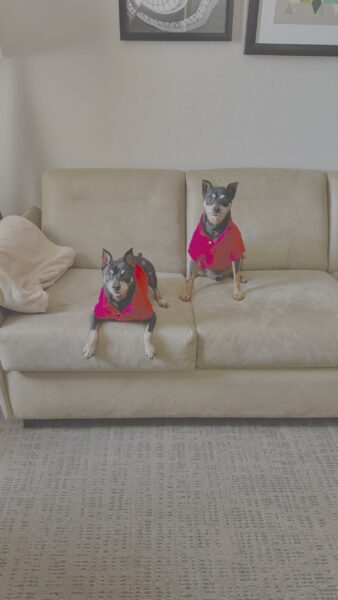
Shelagh Hardrich’s miniature pinschers.
__________
Shelagh Hardrich is a writer and illustrator based in Omaha, Nebraska. “The New Human” is her first published work. She is currently writing and illustrating a vampire-zombie apocalypse series, of which Scout is a beloved supporting character — and, as this story proves, capable of carrying the whole thing herself. Shelagh shares her home with a pack of Miniature Pinschers, though her dream dog has always been a German Pinscher — which is, not coincidentally, exactly what Scout is. When she isn’t writing, she runs Pup Plaza, a dog-focused non-profit in Omaha. She posts work-in-progress art at @sapphic.bookwyrm on Instagram.
__________

To learn more about submitting your work to Boudin or applying to McNeese State University’s Creative Writing MFA program, please visit Submissions for details.
Posted in Third Annual Pet Writing Contest and tagged in #boudin, #fiction, Fiction